
Ahl-e-Bayt

The Testimony of Safiyya bint Huyayy: From Jewish Princess to Muslim Mother of the Believers

testimony of safiyya

The Testimony of Safiyya bint Huyayy: From Jewish Princess to Muslim Mother of the Believers

Introduction: The Princess of Khaybar

The testimony of Safiyya is a unique narrative in Islamic history. Safiyya bint Huyayy ibn Akhtab was the daughter of a Jewish chieftain from Khaybar who later became the purified wife of the Messenger of Allah (PBUH). Her embrace of Islam and her powerful testimony stand as clear evidence of Islam’s universal message of peace and acceptance.

Family Background and Lineage

To understand the testimony of Safiyya, one must know her family context. Safiyya bint Huyayy was the daughter of Huyayy ibn Akhtab, the chief of the Banu Nadir tribe. Her family was highly respected among the Jews, and her father was a major leader of the Jewish tribes in Medina.

First Marriage and the Battle of Khaybar

Before her testimony, it’s important to know the circumstances of her life. Her first marriage was to Sallam ibn Mishkam, which ended in divorce. She then married Kinana ibn al-Rabi’, a Jewish chieftain of Khaybar. During the Battle of Khaybar, both her husband and father were killed, and Safiyya was taken as a prisoner of war.

Captivity and Presentation to the Prophet (PBUH)

The testimony of Safiyya began after this captivity. When she was presented to the Messenger of Allah (PBUH), he (PBUH) granted her freedom and presented Islam to her. Safiyya wholeheartedly accepted Islam and gave her testimony (Shahada) that there is no god but Allah, and Muhammad is His Messenger.

Marriage to the Prophet Muhammad (PBUH)

Following her testimony, the Prophet Muhammad (PBUH) married her. This marriage became a means of fostering peace and reconciliation between Jews and Muslims. Safiyya became a Mother of the Believers (Umm al-Mu’minin) and devoted her entire life to the service of Islam.

The Spiritual Dimensions of Safiyya’s Testimony

The testimony of Safiyya was not merely a verbal declaration; it held deep spiritual meaning. She not only recited the declaration of faith with her tongue but accepted Islam with her entire heart and soul. Her life became a practical interpretation of her testimony.

Services as a Mother of the Believers

After her testimony, she performed remarkable services as a Mother of the Believers:

  • Scholarly Contributions: Safiyya bint Huyayy played a significant role in disseminating Islamic knowledge. She taught the Quran and instructed women on religious matters.

  • Social Services: She placed special emphasis on the education and upbringing of women in society. She made Muslim women aware of their rights and made special arrangements for their education.

  • Guidance and Counsel: Safiyya bint Huyayy guided the Muslim community with her knowledge and experience. Her role was particularly important in relations with Jewish communities.

Narration of Hadith

After her testimony, she narrated several Ahadith (traditions) from the Prophet Muhammad (PBUH). Some of the themes of the narrations include:

  • The moral teachings of the Prophet (PBUH)

  • Ahadith concerning women’s rights

  • Teachings on interfaith relations

Historical Impact of Safiyya’s Testimony

The testimony of Safiyya had several historical impacts:

  • Interfaith Harmony: Her conversion improved relations between Jews and Muslims.

  • Education of Women: She performed notable services for the education and training of Muslim women.

  • Dissemination of Islamic Teachings: Safiyya bint Huyayy played a key role in spreading Islamic teachings through her knowledge.

Modern-Day Lessons from Safiyya’s Testimony

The testimony of Safiyya holds many lessons for us today:

  • Interfaith Tolerance: Her acceptance of Islam is an excellent example of interfaith tolerance and mutual respect.

  • Women’s Rights: Her life is a model for Muslim women.

  • Importance of Knowledge: She highlighted the importance of knowledge and encouraged Muslim women to seek education.

Death and Legacy

Safiyya bint Huyayy passed away in 50 AH (670 CE) and was buried in Jannat al-Baqi. Even after her death, the testimony of Safiyya and her services remain a guiding light for us.

Mention in Historical Sources
The testimony of Safiyya and details of her life are found in numerous historical sources, including:

  • Sahih al-Bukhari

  • Sahih Muslim

  • Sunan Abi Dawud

  • Al-Tabari’s History

  • Ibn Hisham’s Sirat

  • Al-Isabah fi Tamyiz al-Sahabah

Message for the Present Day
From the testimony of Safiyya, we can derive the following lessons:

  • Tolerance and Patience: Her life is a superb example of interfaith tolerance.

  • Women’s Education: She highlighted the importance of women’s education.

  • Steadfastness: She demonstrated unwavering steadfastness after accepting Islam.

Closing Dua
“O Allah, have mercy on Safiyya bint Huyayy and make her among the people of Paradise, and make us among those who listen to speech and follow the best of it.”

Sources and References:

  • Sahih al-Bukhari

  • Sahih Muslim

  • Sunan Abi Dawud

  • Sunan al-Tirmidhi

  • Sirat Ibn Ishaq

  • Sirat Ibn Hisham

  • Tarikh al-Tabari

  • Al-Isabah fi Tamyiz al-Sahabah
Join Us on Social Media

Abdullah ibn Salam Islam: The Inspiring Story of a Jewish Scholar’s Journey to Faith

Abdullah ibn Salam Islam

Introduction: Abdullah ibn Salam Islam

Abdullah ibn Salam’s conversion to Islam stands as one of the most significant events in Islamic history. Before embracing Islam, he was among Medina’s most renowned Jewish scholars from the Banu Qaynuqa tribe. His deep knowledge of the Torah and recognition of Prophet Muhammad (PBUH) make his story particularly compelling for Muslims and non-Muslims alike.

Historical Background: Medina’s Religious Landscape

During the time of Prophet Muhammad’s (PBUH) migration to Medina, the city was home to several Jewish tribes who were well-versed in their scriptures. Abdullah ibn Salam stood out as one of the most knowledgeable Torah scholars, respected for his wisdom and understanding of divine scriptures.

Early Life and Scholarly Achievements

Born as Husayn ibn Salam into a prestigious Jewish family, Abdullah ibn Salam received extensive religious education from family elders. His father, Salam ibn al-Harith, was a tribal leader, and his mother came from a noble family. By his youth, Abdullah had already established himself as a leading Torah scholar in Medina.

Recognizing the Prophet from Torah prophecies

Through his deep study of the Torah and other divine scriptures, Abdullah ibn Salam had learned about the coming of the final Prophet. He was among those waiting for this promised Messenger and was prepared to recognize him through the signs mentioned in the Jewish scriptures.

The First Meeting and Immediate Acceptance

When Prophet Muhammad (PBUH) arrived in Medina, Abdullah ibn Salam was among the first to meet him. He immediately recognized the Prophet from the descriptions in the Torah and declared the Shahadah without hesitation. This instant recognition and acceptance demonstrate his profound knowledge and spiritual insight.

Challenges After Conversion

Abdullah ibn Salam’s conversion to Islam faced severe opposition from his family and tribe. They threatened him and launched propaganda campaigns against him. Despite these challenges, he remained steadfast in his faith, demonstrating remarkable courage and commitment to Islam.

Special Attention from Prophet Muhammad (PBUH)

The Prophet (PBUH) held Abdullah ibn Salam in high esteem due to his knowledge and wisdom. He entrusted him with the important task of engaging in dialogues and debates with Jewish and Christian scholars, leveraging his deep understanding of their scriptures.

Intellectual Contributions to Islam

Abdullah ibn Salam made significant contributions to Islamic knowledge:

Quranic Commentary

His expertise in previous scriptures helped in explaining Quranic verses related to People of the Book

Hadith Narration

He narrated several authentic hadiths that are preserved in major collections

Interfaith Dialogue

He engaged in scholarly debates with Jewish and Christian scholars

Military Service and Participation

Abdullah ibn Salam participated in several battles, providing both physical and intellectual support to the Muslim community. His strategic insights and religious guidance proved valuable during military campaigns.

Personal Characteristics and Ethics

Abdullah ibn Salam was known for his:

Academic Integrity

He maintained honesty and truthfulness in all scholarly matters

Humility and Modesty

Despite his knowledge, he remained humble and approachable

Patience and Perseverance

He demonstrated remarkable patience in facing challenges after his conversion

Legacy and Passing

Abdullah ibn Salam passed away in 43 AH in Medina and was buried in Jannat al-Baqi. His descendants continued his legacy of knowledge and service to Islam.

Lessons for Contemporary Times

Abdullah ibn Salam’s story teaches us:

The Importance of Knowledge

True knowledge leads to recognition of truth

Courage in Faith

Standing firm in belief despite opposition

Interfaith Understanding

The value of respectful dialogue between religions

Spiritual Recognition

The ability to recognize truth through spiritual insight

Conclusion: An Enduring Inspiration

Abdullah ibn Salam’s journey from being a Jewish scholar to becoming a devoted Muslim companion serves as an eternal inspiration for seekers of truth. His story demonstrates how knowledge, when combined with sincerity, leads to recognition of divine truth.

Final Prayer

“O Allah, shower Your mercy upon Abdullah ibn Salam and make him among the inhabitants of Paradise. Grant us the ability to follow his example of seeking knowledge and recognizing truth. Ameen.”


Sources and References:

  1. Sahih al-Bukhari

  2. Sahih Muslim

  3. Sunan Abi Dawud

  4. Sunan at-Tirmidhi

  5. Sirat Ibn Ishaq

  6. Sirat Ibn Hisham

  7. Tarikh at-Tabari

  8. Al-Isabah fi Tamyiz as-Sahabah

Join Us on Social Media

Abu Qays ibn Abi Anas: The Life and Legacy of an Ansari Companion

Abu Qays ibn Abi Anas

Abu Qays ibn Abi Anas (RA) stands as a shining example of the Ansar (Helpers) of Medina, who played an instrumental role in the establishment and spread of Islam. As a member of the esteemed Aus tribe, his life reflects the profound commitment and sacrifice that characterized the early Muslim community. His story offers invaluable insights into the challenges and triumphs of Islam’s formative years.

Historical Context: Medina Before and After Islam

To fully appreciate Abu Qays’ contributions, one must understand the social and political landscape of pre-Islamic Medina. The city was divided by longstanding tribal conflicts, particularly between the Aus and Khazraj tribes. Abu Qays’ acceptance of Islam and his subsequent efforts to promote unity exemplify the transformative power of the Islamic message in healing societal divisions and fostering brotherhood.

Family Background and Early Life

Abu Qays hailed from the Banu Harithah ibn al-Harith clan of the Aus tribe, one of Medina’s most respected families. His father, Abu Anas Ma’adh bin ‘Afra, was a prominent figure in Medinan society, known for his wisdom and leadership. This noble lineage provided Abu Qays with a strong foundation for his future role as a Muslim leader and community builder.

Conversion to Islam: A Transformative Journey

Abu Qays’ conversion to Islam following the Hijrah represents a significant moment in Islamic history. His decision to embrace the faith demonstrates the powerful impact of the Prophet’s (PBUH) message on the people of Medina. Unlike many companions who faced persecution for their beliefs, Abu Qays’ conversion occurred in the supportive environment of Medina, yet it still required considerable courage to break from traditional tribal norms.

Military Contributions: defending the Early Muslim Community

Battle of Badr: The First Test of Faith

Abu Qays’ participation in the Battle of Badr (2 AH/624 CE) marked his first major military engagement as a Muslim. Despite being new to warfare, he fought with remarkable bravery alongside the Muhajirun and other Ansar. His performance in this decisive battle demonstrated his complete commitment to the Islamic cause.

Battle of Uhud: steadfastness in adversity

During the Battle of Uhud (3 AH/625 CE), Abu Qays played a crucial role in protecting the Prophet (PBUH) during the most challenging moments of the conflict. His unwavering loyalty during this difficult test earned him respect among the companions and highlighted his exceptional character.

Battle of the Trench: Community Spirit and Innovation

Abu Qays’ contributions to the Battle of the Trench (5 AH/627 CE) extended beyond combat. He actively participated in digging the trench, showing that manual labor for the community’s defense was just as honorable as fighting on the front lines. This attitude embodied the Islamic values of humility and collective effort.

Other Military Campaigns

Abu Qays continued to serve in subsequent military engagements, including the Battle of Khaybar (7 AH/628 CE), the Conquest of Mecca (8 AH/630 CE), and the Battle of Hunayn (8 AH/630 CE). His consistent participation in these campaigns shows his enduring dedication to defending and spreading Islam.

Contributions to Islamic Education and Knowledge

Beyond his military service, Abu Qays made significant contributions to Islamic education:

  1. Quranic Instruction: He served as a Quran teacher, helping to preserve and transmit the divine revelation

  2. Hadith Narration: He transmitted several important hadiths concerning prayer, charity, and jihad

  3. Educational Institution: He established a learning center in Medina that became a model for future Islamic schools

  4. Community Education: He organized educational programs for new Muslims, ensuring proper understanding of Islamic principles

Social Reforms and Community Development

Abu Qays recognized that building a strong Muslim community required addressing social needs:

  1. Social Welfare Systems: He developed comprehensive systems for orphan care and poverty alleviation

  2. Economic Development: He introduced innovative agricultural techniques and supported local trade

  3. Inclusive Community Building: He ensured that vulnerable community members, including the disabled, received proper care and support

  4. Intercommunity Relations: He worked to maintain positive relationships between different tribal groups in Medina

Spiritual Legacy and Personal Character

Those who knew Abu Qays described him as embodying the highest Islamic values:

  1. Integrity: His honesty and trustworthiness became legendary in Medina

  2. Compassion: He was known for his generosity and concern for the less fortunate

  3. Courage: He faced challenges with remarkable bravery and determination

  4. Humility: Despite his achievements, he remained modest and approachable

Historical Accounts and Documentation

The preservation of Abu Qays’ story through multiple historical sources demonstrates his importance in early Islamic history. Major historians including Ibn Athir, Ibn Hajar al-Asqalani, and Ibn Sa’d documented his life and contributions, ensuring that future generations would remember his example.

Relevance for Contemporary Muslims

Abu Qays’ life offers important lessons for modern Muslims:

  1. Community Service: His dedication to social welfare reminds us of our responsibility to serve society

  2. Lifelong Learning: His commitment to education emphasizes the importance of knowledge in Islam

  3. Intercommunity Harmony: His efforts to build bridges between different groups provide a model for contemporary community relations

  4. Balanced Living: His ability to combine military service, educational work, and social reform shows the importance of comprehensive engagement with society

Conclusion: An Enduring Legacy

Abu Qays ibn Abi Anas represents the best of the Ansar – those who welcomed, supported, and sacrificed for the Muslim community without seeking reward or recognition. His life demonstrates how ordinary individuals can achieve extraordinary things through faith, dedication, and service to others.

Final Prayer

“O Allah, shower Your mercy upon Abu Qays ibn Abi Anas and all the companions of Your Prophet. Grant us the ability to follow their example and unite us with them in Paradise. Ameen.”


Sources and References:

  1. Usd al-Ghabah fi Ma’rifat al-Sahabah – Ibn Athir

  2. Al-Isabah fi Tamyiz al-Sahabah – Ibn Hajar al-Asqalani

  3. Tabaqat Ibn Sa’d

  4. Tarikh al-Tabari

  5. Sirat Ibn Hisham

  6. Al-Isti’ab fi Ma’rifat al-Ashab – Ibn Abd al-Barr

  7. Ma’rifat al-Sahabah – Abu Nu’aym al-Isfahani

  8. Hilyat al-Awliya – Abu Nu’aym al-Isfahani

Join Us on Social Media

Beginning of the Adhan: The Historic Moment of Islam’s First Call to Prayer

Beginning of the Adhan

Introduction: The Divine Revelation of the Adhan

The beginning of the Adhan marks one of the most significant events in Islamic history. This heavenly-inspired call to prayer not only transformed how Muslims are summoned to worship but also became the spiritual heartbeat of the Muslim community. The beginning of the Adhan represents Allah’s perfect guidance in establishing a unique identity for the Muslim Ummah.

Historical Context: Before the Adhan

Before the beginning of the Adhan, Muslims used various methods to announce prayer times. In early Medina, the growing Muslim community needed a distinctive way to call believers to prayer. Suggestions included using bells like Christians or horns like Jews, but Prophet Muhammad (PBUH) rejected these imitation practices, seeking a unique Islamic method.

The Divine Dream of Abdullah ibn Zayd

The beginning of the Adhan started with a miraculous dream of Abdullah ibn Zayd (RA). He saw an angel teaching him the words of the Adhan in his sleep. Upon waking, he immediately reported this vision to Prophet Muhammad (PBUH), who confirmed it as a true revelation and commanded that these words be used for the call to prayer.

The First Adhan: Bilal’s Historic Moment

The beginning of the Adhan occurred when Bilal ibn Rabah (RA) ascended to the roof of the Masjid an-Nabawi and delivered the first call to prayer. His powerful voice echoed through the streets of Medina, marking the first time the words of the Adhan were heard by human ears. This moment established the tradition that continues unchanged to this day.

The Words of the Adhan: Spiritual Significance

The beginning of the Adhan introduced profound words that contain deep spiritual meanings:

  • Allahu Akbar: Declaration of Allah’s greatness

  • Ashhadu an la ilaha illallah: Testimony of Allah’s oneness

  • Ashhadu anna Muhammadan Rasulullah: Testimony of Prophet’s messengership

  • Hayya alas Salah: Call to prayer

  • Hayya alal Falah: Call to success

  • Allahu Akbar: Reaffirmation of divine greatness

  • La ilaha illallah: Final testimony of faith

Bilal ibn Rabah: The First Mu’adhin

The beginning of the Adhan saw the appointment of Bilal ibn Rabah (RA) as Islam’s first Mu’adhin. His selection was due to his powerful voice, strong faith, and pure heart. Despite his humble origins as an freed slave, Bilal’s voice became the symbol of Islamic equality and devotion.

Virtues and Rewards of the Adhan

Since the beginning of the Adhan, numerous virtues have been associated with this sacred call:

  • Prophetic saying: “When the Mu’adhin calls the Adhan, Satan runs away”

  • Divine forgiveness: “Everything that hears the Mu’adhin’s voice seeks forgiveness for him”

  • Answered prayers: “Supplications made between Adhan and Iqamah are not rejected”

Global Impact of the Adhan

The beginning of the Adhan has had worldwide effects:

  1. Spiritual Impact: Connects Muslims to Allah five times daily

  2. Social Impact: Creates discipline and community cohesion

  3. Cultural Impact: Becomes an identifier of Islamic presence

  4. Temporal Impact: Teaches time management and punctuality

The Adhan Around the World

Since the beginning of the Adhan, different cultures have developed unique styles:

  • Arab World: Traditional powerful delivery

  • Turkey: Distinct melodic style

  • South Asia: Sweet and harmonious tones

  • Southeast Asia: Soft and melodious rendering

Modern Challenges and Solutions

The beginning of the Adhan faced new challenges in modern times:

  1. Urban Noise: Competition with city sounds

  2. Legal Restrictions: Some countries limit Adhan volume

  3. Technological Adaptation: Use of speakers and digital systems

  4. Cultural Integration: Maintaining tradition while adapting to local contexts

Spiritual Benefits of the Adhan

The beginning of the Adhan brought numerous blessings:

  1. Protection from Satan: Devils flee from the Adhan

  2. Acceptance of Prayers: Special time for dua acceptance

  3. Forgiveness of Sins: Listeners receive spiritual cleansing

  4. Increased Rewards: Mu’adhins receive immense blessings

Scientific Aspects of the Adhan

Modern science has revealed amazing facts since the beginning of the Adhan:

  1. Sound Therapy: Soothing effects on human psychology

  2. Brain Impact: Positive influence on mental state

  3. Environmental Effects: Creates peaceful atmosphere

  4. Health Benefits: Lowers stress and anxiety levels

Teaching Children About Adhan

The beginning of the Adhan tradition includes children’s education:

  1. Newborn Ritual: Whispering Adhan in babies’ ears

  2. Educational Importance: Teaching Adhan to children

  3. Practical Training: Encouraging youth to learn calling

  4. Reward Awareness: Teaching spiritual benefits

Etiquette and Sunnahs of Adhan

The beginning of the Adhan established proper etiquette:

  1. Before Adhan: Performing ablution, facing Qiblah

  2. During Adhan: Listening attentively, repeating words

  3. After Adhan: Making dua, sending blessings

  4. Special Manners: Special attention when in marketplace

Conclusion: The Eternal Call

The beginning of the Adhan represents Allah’s mercy and guidance for the Muslim Ummah. This divine institution continues to unite Muslims worldwide, reminding them of their purpose and connecting them to their Creator five times daily.

Final Dua

“O Allah! Lord of this perfect call and established prayer, grant Muhammad the intercession and favor, and raise him to the praised position that You have promised him.”


Sources and References:

  1. Sahih al-Bukhari (Book of Adhan)

  2. Sahih Muslim (Book of Prayer)

  3. Sunan Abi Dawud (Book of Prayer)

  4. Sunan at-Tirmidhi (Chapters on Prayer)

  5. Sirat Ibn Hisham

  6. Tarikh at-Tabari

  7. Ar-Raheeq Al-Makhtum

  8. Zad Al-Ma’ad

Join Us on Social Media

Prophet Muhammad Establishes Brotherhood Muhajireen Ansar

Muhajireen Ansar Brotherhood

Introduction:  Muhajireen Ansar Brotherhood

When Prophet Muhammad (PBUH) established the brotherhood between Muhajireen and Ansar in Medina, it was not merely a social agreement but a revolutionary concept of Islamic brotherhood. Muhajireen Ansar Brotherhood was actually that magnificent act that not only transformed the social structure of Medina but established a living example of brotherhood and equality for all humanity. This unique initiative redefined social relationships and created a model of community living that continues to inspire generations.

Historical Background: Post-Hijrah Challenges

When the Muhajireen migrated from Mecca to Medina, they faced enormous economic and social challenges. The Muhajireen had left everything behind in Mecca, while the Ansar had limited resources. In such circumstances, Prophet Muhammad (PBUH) established Muhajireen Ansar Brotherhood, which not only solved economic problems but laid the foundation of a society where brotherhood and equality received the highest importance. The situation demanded immediate action as the Muhajireen were without homes, livelihoods, or social support in their new environment.

The Ceremony of Muakhat: A Revolutionary Step

Prophet Muhammad (PBUH) organized a ceremony in Masjid an-Nabawi where bonds of brotherhood were established between Muhajireen and Ansar. This ceremony represented:

  1. 90 Pairs Formed: 45 pairs of brothers between Muhajireen and Ansar

  2. Rights and Responsibilities: Clear determination of rights and obligations for both parties

  3. Economic Cooperation: Ansar shared everything they had with their Muhajir brothers

  4. Emotional Connection: Bonds of hearts were established beyond material relationships

This ceremony wasn’t just symbolic; it involved practical commitments where each Ansari took specific responsibility for his Muhajir brother’s welfare, including housing, financial support, and emotional companionship.

Magnificent Examples of Brotherhood

Muhajireen Ansar Brotherhood produced several magnificent examples written in golden letters in history:

Abdur Rahman bin Auf and Sa’ad bin Rabi:
Sa’ad bin Rabi offered his Muhajir brother:
“Take half of my wealth and choose one of my two wives”
Abdur Rahman bin Auf responded:
“May Allah bless your wealth and your wives, just show me the way to the market”

Abu Bakr Siddiq and Harith bin Khazimah:
Harith bin Khazimah handed over his entire house and business to Abu Bakr Siddiq without hesitation

Other Notable Pairs:

  • Umar bin Khattab with Itban bin Malik

  • Uthman bin Affan with Aus bin Thabit

  • Ali bin Abi Talib with Abu Ayyub Ansari

These examples demonstrate the extraordinary level of sacrifice and commitment that characterized this brotherhood.

Quranic Verses and Hadith About Muakhat

The Quran clearly mentions the greatness of Muhajireen Ansar Brotherhood:

Surah Al-Hashr (59:9):
“وَالَّذِينَ تَبَوَّءُوا الدَّارَ وَالْإِيمَانَ مِن قَبْلِهِمْ يُحِبُّونَ مَنْ هَاجَرَ إِلَيْهِمْ وَلَا يَجِدُونَ فِي صُدُورِهِمْ حَاجَةً مِّمَّا أُوتُوا وَيُؤْثِرُونَ عَلَىٰ أَنفُسِهِمْ وَلَوْ كَانَ بِهِمْ خَصَاصَةٌ”

Translation: “And those who, before them, had homes (in Medina) and had adopted the Faith, show their affection to such as came to them for refuge, and entertain no desire in their hearts for things given to the (latter), but give them preference over themselves, even though poverty was their (own lot).”

Prophetic Traditions:
The Prophet (PBUH) said: “None of you truly believes until he loves for his brother what he loves for himself” (Sahih al-Bukhari)
“The believers in their mutual kindness, compassion, and sympathy are just like one body. When one of the limbs suffers, the whole body responds to it with wakefulness and fever” (Sahih Muslim)

Economic Impacts of Muakhat

Muhajireen Ansar Brotherhood had far-reaching economic impacts:

  1. Economic Self-Sufficiency: Muhajireen quickly became economically self-reliant

  2. Business Partnerships: Business partnerships established between both groups

  3. Agricultural Reforms: Promotion of modern agricultural methods

  4. Trade Network: Establishment of international trade relations

  5. Wealth Distribution: Effective redistribution of resources

  6. Skill Development: Transfer of skills and knowledge

  7. Market Development: Establishment of new markets and trade routes

The economic system established through this brotherhood became a model for Islamic economics, emphasizing fair distribution, mutual cooperation, and social welfare.

Social and Cultural Impacts

Muhajireen Ansar Brotherhood had profound social and cultural impacts:

  1. Cultural Harmony: Beautiful blend of different cultures

  2. Social Justice: Equal rights for all social classes

  3. Educational Progress: Promotion of knowledge and wisdom

  4. Moral Training: Development of high moral values

  5. Social Cohesion: Strengthened community bonds

  6. Inter-tribal Unity: Breakdown of tribal prejudices

  7. Community Welfare: Collective responsibility for social welfare

This brotherhood transformed Medina from a city divided by tribal conflicts into a unified community based on faith and mutual respect.

Political and Administrative Impacts

The establishment of brotherhood had significant political implications:

  1. Political Unity: Created a unified Muslim community

  2. Administrative Structure: Established a model of Islamic governance

  3. Conflict Resolution: Provided mechanism for dispute resolution

  4. Social Security: Created a comprehensive social security system

  5. Community Leadership: Developed new leadership patterns

This political transformation made Medina capable of facing external challenges and establishing a successful Islamic state.

Modern Relevance and Lessons

Muhajireen Ansar Brotherhood remains relevant today:

For Contemporary Society:

  1. Intercommunity Relations: Model for intercommunity harmony

  2. Refugee Support: Framework for supporting migrants and refugees

  3. Social Welfare: Blueprint for social welfare systems

  4. Economic Justice: Model for economic cooperation

  5. Conflict Resolution: Approach for resolving social conflicts

For Muslim Communities:

  1. Unity and Brotherhood: Importance of maintaining unity

  2. Social Responsibility: Collective responsibility for community welfare

  3. Economic Cooperation: Need for mutual economic support

  4. Cultural Integration: Value of cultural harmony

  5. Spiritual Development: Role of brotherhood in spiritual growth

Implementation in Modern Context

The principles of Muhajireen Ansar Brotherhood can be implemented today through:

  1. Community Programs: Establishing brotherhood programs in communities

  2. Economic Initiatives: Creating mutual support economic systems

  3. Educational Programs: Teaching values of brotherhood and unity

  4. Social Services: Developing community-based social services

  5. Interfaith Dialogue: Promoting understanding between different groups

Challenges and Solutions

Implementing this model today faces challenges:

  1. Materialism: Overcoming materialistic attitudes

  2. Individualism: Addressing excessive individualism

  3. Social Divisions: Bridging social and economic divisions

  4. Cultural Barriers: Overcoming cultural and ethnic prejudices

  5. Implementation: Developing practical implementation strategies

Solutions include religious education, community building, economic reforms, and social programs that promote Islamic values of brotherhood.

Conclusion: Eternal Lessons

Muhajireen Ansar Brotherhood provides eternal lessons for humanity:

  1. Power of Unity: Strength comes through unity and brotherhood

  2. Social Justice: Importance of economic and social justice

  3. Divine Guidance: Success comes through following divine guidance

  4. Human Dignity: Every human deserves dignity and respect

  5. Eternal Values: Islamic values are relevant for all times

This brotherhood remains a shining example of how faith can transform society and create bonds stronger than blood relationships.

Final Prayer

“O Allah! Make us among those who listen to the word and follow the best thereof, make us among those who follow the Sunnah of Your Noble Prophet, and admit us into Your vast mercy.”


Sources and References:

  1. Sahih al-Bukhari (Book of Brotherhood)

  2. Sahih Muslim (Book of Brotherhood)

  3. Sirat Ibn Hisham

  4. Tarikh al-Tabari

  5. Al-Raheeq Al-Makhtum

  6. Zad Al-Ma’ad

  7. Al-Tabaqat al-Kubra

  8. Al-Bidayah wa al-Nihayah

Join Us on Social Media

The Historical Document of Hazrat Ali: Strengthening the Bonds Between Muhajireen and Ansar and Reconciliation with the Jews

Hazrat Ali's Document

Hazrat Ali’s Document: A Masterpiece of Islamic Diplomacy and Unity

Hazrat Ali’s document is a magnificent piece of Islamic history, written to strengthen the mutual relations between the Muhajireen (migrants) and Ansar (helpers) and to establish reconciliation with the Jews. This document was not merely a political masterpiece but also a practical interpretation of Islamic principles. It not only provided solutions to existing problems but also left a living example of interfaith harmony for future generations. Hazrat Ali’s document is, in fact, the first chapter of Islamic law and international relations, proving that Islam teaches mutual respect for differences of opinion.

Historical Background: The Delicate Situation in Medina

After the passing of the Prophet Muhammad (PBUH), the Islamic state faced new challenges, and Hazrat Ali’s document addressed the following issues. At that time, the challenges in Medina were highly complex. The Muhajireen had migrated from Mecca with few worldly resources. The Ansar had shared everything they had, but resources were limited. On the other hand, tensions were rising with the Jewish tribes. In such a situation, Hazrat Ali’s document not only resolved issues of social justice and economic balance but also gave a new direction to interfaith relations.

Key Features of the Document: Juristic and Literary Excellence

Hazrat Ali’s document possessed the following characteristics. It had both juristic depth and literary elegance. It was not merely an agreement but a comprehensive charter of interfaith relations based on Islamic principles. Hazrat Ali’s document clearly outlined the rights and duties of the Muhajireen and Ansar, as well as the legal status of the agreement with the Jews. The principles of economic justice were presented with exceptional skill.

Literary Aspect: Exceptional Eloquence and Clarity

Hazrat Ali’s document exhibited a high standard of eloquence and clarity. The beauty of its legal language gave it a unique place. The harmonious blend of political wisdom and religious requirements was its special feature. Its coverage of the etiquette of international relations made it an ideal document for interfaith relations. The language used in Hazrat Ali’s document was not only clear and comprehensive but also carried a certain diplomatic finesse.

Key Points of the Document: A Detailed Overview

Hazrat Ali’s document included the following key points. It was not just an ordinary agreement but a comprehensive manual that considered every aspect. It emphasized building a strong bond of brotherhood between the Muhajireen and Ansar. Under economic justice, it ensured the fair distribution of financial rights. To maintain political balance, it guaranteed appropriate representation in government positions. For social harmony, it promoted mutual cooperation and tolerance.

Measures for Reconciliation with the Jews

Hazrat Ali’s document proposed highly comprehensive measures for reconciliation with the Jews. Under religious freedom, it ensured the liberty of worship and religious practices. Under the protection of economic rights, it safeguarded trade and agricultural rights. For defensive cooperation, it formed mutual defense agreements. For judicial justice, it established methods for resolving legal disputes. Hazrat Ali’s document is, in fact, an outstanding example for interfaith relations.

Mention in Historical Documents

Hazrat Ali’s document is mentioned in the following historical sources. Tarikh al-Tabari clearly states, “Ali ibn Abi Talib wrote a document of reconciliation with the Jews.” Al-Kamil fi al-Tarikh mentions it as “the document of agreement between the Muhajireen and Ansar by Ali al-Murtaza.” Maqatil al-Talibiyyin contains a detailed account of the agreement with the Jewish tribe of Banu Qurayza. Nahj al-Balagha includes sermons on interfaith relations that help understand the spirit of this document.

Effects of the Document: Historical Changes

Hazrat Ali’s document had the following far-reaching effects. Short-term effects included the resolution of differences between the Muhajireen and Ansar. Relations with Jewish tribes improved significantly. The stability of the Islamic state increased markedly. Economic growth and prosperity ushered in a new era. Long-term effects included guidance for interfaith relations. The document played a key role in shaping the Islamic legal system. It helped balance political expediency and religious principles. It established Islamic principles for international relations.

Guidance for the Modern Era

Hazrat Ali’s document remains a source of guidance for us today. For interfaith relations, it is essential to understand the importance of dialogue and discourse. Promoting mutual respect and tolerance is a critical need of the time. Cooperation on common interests must be encouraged. Mutual resolution of differences should be prioritized. For national unity, the need for brotherhood and solidarity is paramount. The importance of economic justice must be understood. The need for political balance should not be overlooked. The requirements of social harmony must be fulfilled.

Excerpts from the Document: Literary Gems

Some memorable excerpts from Hazrat Ali’s document continue to guide us today. The lesson, “Hold firmly to the rope of Allah and do not divide,” teaches us the importance of unity. The concept, “Muhajireen and Ansar are brothers to one another,” makes us aware of the greatness of brotherhood. The principle, “Treat the Jews with the same justice you desire for yourselves,” lays the foundation for interfaith justice. The philosophy, “Resolve differences of opinion with mutual respect,” teaches us tolerance.

Final Word: A Living Lesson

Hazrat Ali’s document is no ordinary document but a living lesson. It teaches us that it is possible to maintain unity despite differences. It shows that people of different religions can live together peacefully. It teaches that justice and tolerance are the foundations of a successful society. Hazrat Ali’s document is, in fact, a practical interpretation of Islam’s universal message.

Closing Prayer

“O Allah, show us the truth as truth and grant us the ability to follow it, and show us falsehood as falsehood and grant us the ability to avoid it.”


Sources and References:

  1. Tarikh al-Tabari

  2. Al-Kamil fi al-Tarikh

  3. Maqatil al-Talibiyyin

  4. Nahj al-Balagha

  5. Sharh Nahj al-Balagha

  6. Tarikh Ibn Khaldun

  7. Books on Islamic History

  8. Sources of Seerah Literature

Join Us on Social Media

The First Sermons of Prophet Muhammad (PBUH) and the Constitution of Medina: Foundations of the First Islamic State

Prophet Muhammad First Sermon

The First Sermons of Prophet Muhammad (PBUH) and the Constitution of Medina: Cornerstones of Islamic History

Introduction: The Dawn of a New Era in Medina

The arrival of Prophet Muhammad in Medina marked not just a physical migration but the beginning of a revolutionary transformation. His first sermon and the subsequent Constitution of Medina laid the groundwork for what would become the first Islamic state, establishing principles that continue to inspire millions worldwide. This historic moment represented a pivotal shift from tribal fragmentation to unified nationhood, creating a model society based on divine guidance and practical wisdom. The Prophet Muhammad first sermon established the spiritual and social framework that would guide the Muslim community for centuries to come.

The First Sermon: Declaration of Fundamental Principles

Upon reaching Medina, Prophet Muhammad delivered his first sermon, which established the core principles of the new Islamic community. This landmark address occurred at the site where Masjid an-Nabawi would later be built, symbolizing the integration of spiritual and temporal leadership. The Prophet Muhammad first sermon addressed the fundamental needs of the nascent Muslim community while establishing timeless principles for human society.

Key Teachings from Prophet Muhammad First Sermon:

  1. Tawhid (Monotheism): The sermon began with the affirmation of Allah’s oneness, establishing the theological foundation for the new community. This principle of monotheism represented a radical departure from the polytheistic practices prevalent in pre-Islamic Arabia.

  2. Islamic Brotherhood: The Prophet Muhammad first sermon emphasized the creation of a unified community where all believers were equal regardless of tribal affiliation, social status, or ethnic background. This concept of Ummah broke down traditional barriers and established a new social order.

  3. Social Responsibilities: The sermon outlined mutual rights and duties within society, emphasizing that Islamic teachings encompassed all aspects of human interaction. This comprehensive approach to social responsibility became a hallmark of Islamic governance.

  4. Moral Foundation: Prophet Muhammad first sermon placed strong emphasis on truthfulness, trustworthiness, and ethical conduct in all matters. These moral principles formed the character of the emerging Muslim society.

  5. Community Welfare: The address established the community’s responsibility toward the weak and vulnerable members of society, creating the world’s first comprehensive social welfare system based on religious principles.

Prophetic Tradition from the First Sermon:
“O people! Spread peace, feed the hungry, maintain family ties, pray at night when people are asleep, and you will enter Paradise in peace.” This comprehensive statement encapsulated the essence of Islamic teachings, combining spiritual devotion with social responsibility.

Historical Context and Significance

The Prophet Muhammad first sermon was delivered at a critical juncture in Islamic history. The Muslim community had just endured thirteen years of persecution in Mecca and was establishing a new home in Medina. The sermon addressed several pressing challenges:

Immediate Challenges:

  • Integration of Muhajireen (Meccan migrants) and Ansar (Medinan helpers)

  • Establishment of inter-tribal harmony among Medina’s diverse population

  • Creation of a functional governance structure

  • Development of economic systems to support the migrants

  • Establishment of peaceful relations with Jewish tribes

The Prophet Muhammad first sermon provided solutions to these challenges by establishing principles of brotherhood, mutual responsibility, and social justice. The address transformed individual Muslims into a cohesive community bound by faith and common purpose.

The Second Sermon: Blueprint for Social Reform

The second sermon complemented Prophet Muhammad first sermon by providing practical guidance for social organization and community building. While the first sermon established philosophical foundations, the second address focused on implementation and practical application.

Essential Directives from the Second Sermon:

  1. Justice and Equality: The sermon established the principle of equal treatment for all citizens regardless of background, creating a revolutionary concept of citizenship in seventh-century Arabia.

  2. Human Rights Protection: Prophet Muhammad outlined specific rights for women, children, slaves, and religious minorities, establishing unprecedented protections in the contemporary world.

  3. Economic System: The address implemented Zakat as a mandatory wealth distribution system, creating the world’s first institutionalized social welfare program.

  4. Educational Emphasis: The sermon stressed the importance of knowledge and learning, making education a fundamental community priority.

  5. Social Harmony: The address promoted cooperation and mutual support, establishing mechanisms for conflict resolution and community development.

The Constitution of Medina: World’s First Written Constitution

This groundbreaking document, drafted under Prophet Muhammad‘s guidance, established Medina as a city-state with sophisticated governance structures. The Constitution represented the practical implementation of principles outlined in Prophet Muhammad first sermon.

Revolutionary Provisions:

  1. Unity of Ummah: The Constitution declared Muslims as one nation despite tribal differences, creating a supra-tribal identity based on faith.

  2. Religious Freedom: The document protected rights for all religious communities, establishing Medina as a multireligious state with equal citizenship.

  3. Collective Defense: The Constitution created a mutual protection agreement among all residents, establishing collective security arrangements.

  4. Judicial System: The document established dispute resolution mechanisms based on Islamic principles, creating an independent judiciary.

  5. Civic Responsibilities: The Constitution outlined clear rights and duties for all citizens, establishing the concept of civic responsibility.

Historical Impact:
The Constitution of Medina represented a revolutionary advancement in governance. It established:

  • The concept of constitutional governance

  • Protection of minority rights

  • Separation of religious and civil authority

  • Rule of law principles

  • Democratic consultation processes

Practical Implementation and Community Building

The principles outlined in Prophet Muhammad first sermon were immediately implemented through practical measures:

Social Programs:

  • Establishment of the first Islamic treasury (Bait ul-Mal)

  • Creation of brotherhood pairs between migrants and helpers

  • Development of agricultural projects for economic sustainability

  • Establishment of educational programs for new Muslims

  • Implementation of regular community meetings for consultation

Economic Reforms:

  • Wealth redistribution through mandatory Zakat

  • Prohibition of usury and exploitative practices

  • Encouragement of trade and commerce

  • Development of public infrastructure projects

  • Establishment of fair market practices

Enduring Principles for Modern Times

The teachings from Prophet Muhammad first sermon continue to offer valuable guidance for contemporary societies:

For Modern Governance:

  1. Social Justice: The sermon’s emphasis on wealth distribution and care for the poor provides models for modern welfare systems.

  2. Interfaith Relations: The principles of religious tolerance and coexistence offer solutions for contemporary religious conflicts.

  3. Human Rights: The early declaration of fundamental rights provides inspiration for modern human rights frameworks.

  4. Community Development: The holistic approach to social organization offers blueprints for sustainable community development.

  5. Moral Leadership: The emphasis on ethical governance provides standards for modern political leadership.

Contemporary Relevance and Applications

Prophet Muhammad first sermon remains remarkably relevant in addressing modern challenges:

Addressing Current Issues:

  • Social inequality and economic disparity

  • Religious intolerance and conflict

  • Governance and corruption challenges

  • Environmental and sustainability concerns

  • Community cohesion and social fragmentation

The principles from Prophet Muhammad first sermon provide timeless guidance for creating just, compassionate, and sustainable societies.

Conclusion: Living Legacy

Prophet Muhammad first sermon and the Constitution of Medina represent more than historical documents; they provide living guidance for human society. These foundational texts offer:

Enduring Values:

  • Timeless principles for social organization

  • Guidance for inter-community relations

  • Framework for ethical governance

  • Inspiration for social justice movements

  • Blueprint for community development

The legacy of Prophet Muhammad first sermon continues to inspire millions worldwide, demonstrating the enduring power of divinely guided leadership and principled governance.


Sources and References:

  1. Sahih al-Bukhari (Book of Sermons)

  2. Sahih Muslim (Book of Leadership)

  3. Sirat Ibn Hisham

  4. Al-Muwatta of Imam Malik

  5. Historical records of Medina Constitution

  6. Islamic legal commentaries

  7. Academic studies on early Islamic governance

  8. Historical analysis of Islamic social systems

Join Us on Social Media

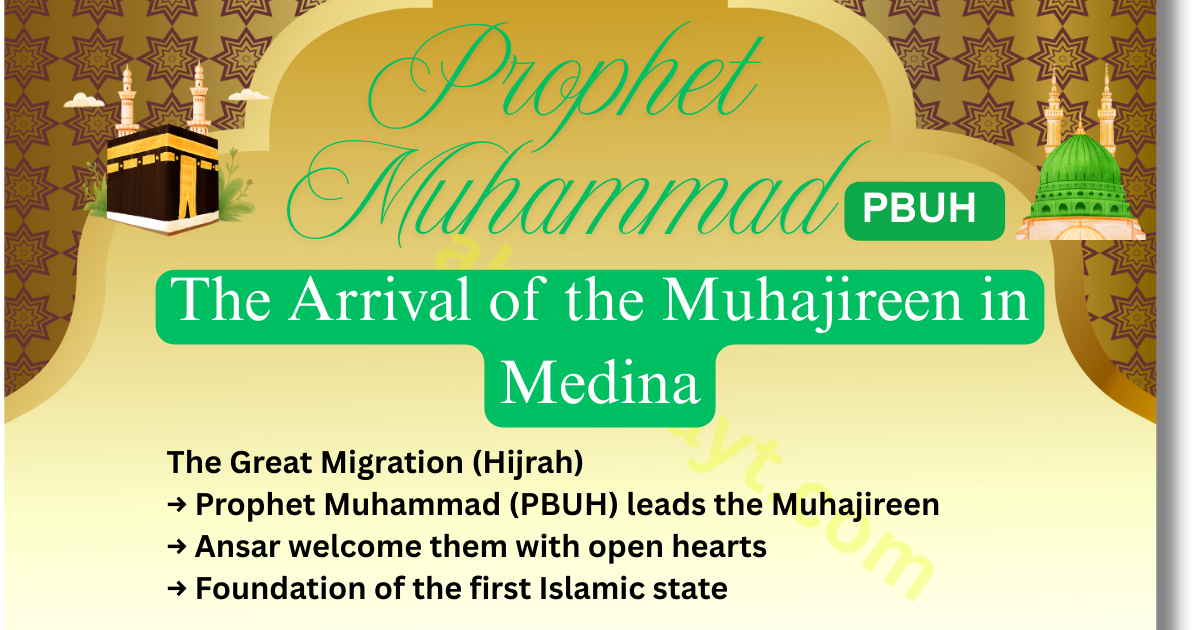
Arrival of Muhajireen in Medina: A Turning Point in Islamic History

Arrival of Muhajireen in Medina

The Arrival of Muhajireen in Medina: A Foundation of Islamic Brotherhood

Introduction: The Significance of the Migration

The arrival of the Muhajireen in Medina is one of the most transformative events in Islamic history. It was not merely a physical relocation but the beginning of a revolutionary movement that laid the foundation for the first Islamic state.

Historical Background of the Migration to Medina

The arrival of the Muhajireen in Medina began when the Muslims of Mecca, facing severe persecution, migrated to Medina on the command of the Prophet Muhammad (PBUH). This event, which took place in 622 CE, became a cornerstone of Islamic history.

The Prophet’s (PBUH) Migration: Guidance and Companionship

The arrival of the Muhajireen in Medina was guided by the leadership of the Prophet Muhammad (PBUH). He himself migrated alongside Hazrat Abu Bakr Siddiq (RA), ensuring the safe and organized transition of the Muhajireen.

The Ansar’s Welcome: An Example of Islamic Brotherhood

When the arrival of the Muhajireen in Medina took place, the Ansar (helpers of Medina) welcomed them with open hearts and unparalleled generosity. They shared everything they had, embodying the spirit of Islamic brotherhood.

Quranic Verse:
“And those who, before them, had homes (in Medina) and had adopted the Faith, love those who emigrate to them…” (Surah Al-Hashr, 59:9)

Muakhah: Brotherhood Between Ansar and Muhajireen

The arrival of the Muhajireen in Medina led to the establishment of Muakhah (brotherhood) between the Ansar and Muhajireen. The Prophet (PBUH) paired each Muhajir with an Ansari, creating bonds of faith and sacrifice.

Challenges Faced by the Muhajireen and Their Solutions

The arrival of the Muhajireen in Medina was not without difficulties. They faced numerous challenges:

  1. Shelter: The Ansar provided homes for the Muhajireen.

  2. Livelihood: Opportunities for trade and employment were created.

  3. Social Integration: Seamless inclusion into the Medinan society.

  4. Emotional Struggles: Coping with the loss of their homeland and loved ones.

Prominent Muhajireen and Their Contributions

The arrival of the Muhajireen in Medina included some of the most illustrious companions of the Prophet (PBUH):

  1. Hazrat Abu Bakr Siddiq (RA)

  2. Hazrat Umar Farooq (RA)

  3. Hazrat Uthman Ghani (RA)

  4. Hazrat Ali Murtaza (RA)

  5. Hazrat Abdul Rahman bin Auf (RA)

Key Events After the Arrival in Medina

The arrival of the Muhajireen in Medina was followed by significant events that shaped Islamic history:

  1. Construction of Masjid Quba: The first mosque in Islamic history.

  2. Establishment of Masjid an-Nabawi: The center of Islamic governance and spirituality.

  3. Implementation of Muakhah: The brotherhood system.

  4. Constitution of Medina: The foundational document of the Islamic state.

Divine Virtues of Migration in the Quran

The arrival of the Muhajireen in Medina is highly praised in the Quran:

Surah Al-Baqarah (2:218):
“Indeed, those who have believed and those who have emigrated and fought in the cause of Allah – those expect the mercy of Allah.”

Surah An-Nahl (16:110):
“Then, indeed your Lord, to those who emigrated after they had been compelled and thereafter fought and remained patient, indeed your Lord, after that, is Forgiving and Merciful.”

Lessons from the Migration

The arrival of the Muhajireen in Medina teaches us invaluable lessons:

  1. Trust in Allah: Relying on divine wisdom during hardships.

  2. Sacrifice: Giving up worldly comforts for the sake of faith.

  3. Brotherhood: Strengthening bonds of unity and compassion.

  4. Patience: Remaining steadfast in the face of adversity.

  5. Unity: Working together for a higher purpose.

Historical Impact of the Migration

The arrival of the Muhajireen in Medina had far-reaching effects:

  1. Establishment of an Islamic State: Medina became the center of Islamic governance.

  2. Spread of Islam: Dawah activities expanded rapidly.

  3. Cultural Transformation: A new societal model based on justice and equality emerged.

  4. Military Organization: The foundation of a defensive Islamic force was laid.

Sacrifices of the Muhajireen and Their Rewards

The arrival of the Muhajireen in Medina involved immense sacrifices:

  • Leaving their homeland behind.

  • Abandoning wealth and properties.

  • Separating from family and loved ones.

  • Giving up established businesses.

Yet, Allah promised them the best of rewards in this life and the hereafter.

Conclusion: A Dua for the Muhajireen and Ansar

“O Allah, have mercy on the Muhajireen and the Ansar and make them among the people of Jannah.”


Sources and References:

  1. Sahih al-Bukhari (Book of Migration)

  2. Sahih Muslim (Book of Leadership)

  3. Sirat Ibn Hisham

  4. Tarikh al-Tabari

  5. Al-Raheeq Al-Makhtum

  6. Zad Al-Ma’ad

Join Us on Social Media

Jinn Accepted Islam | The Miraculous Story of Quran’s

jinn accepted islam

Jinn Accepted Islam | The Quran’s Miraculous Impact on the Unseen World

Islamic history is filled with remarkable events that demonstrate Allah’s power and the Quran’s profound impact. One such extraordinary account is the story of jinn accepting Islam upon hearing Quranic recitation – an event explicitly mentioned in Surah Al-Ahqaf and Surah Al-Jinn of the Holy Quran. This miraculous occurrence not only strengthens faith but contains valuable lessons for all believers.

The Detailed Account: Jinn Hearing the Quran

This miraculous event occurred when Prophet Muhammad (PBUH) was returning from Taif, where he had faced severe persecution and rejection. Despite the emotional pain and physical exhaustion, the Prophet (PBUH) continued his mission with unwavering faith.

During this journey, while the Prophet (PBUH) was engaged in Fajr prayer and Quranic recitation, Allah directed a group of jinn toward him. When these unseen beings heard the Quran, they were utterly captivated. The divine words affected them so profoundly that they stopped to listen attentively, and ultimately embraced Islam.

Quranic Evidence: Surah Al-Ahqaf and Surah Al-Jinn

Allah Almighty describes this event in Surah Al-Ahqaf (46:29-32):

“And [mention, O Muhammad], when We directed to you a few of the jinn, listening to the Quran. And when they attended it, they said, ‘Listen quietly.’ And when it was concluded, they went back to their people as warners.”

Similarly, Surah Al-Jinn (72:1-2) reveals:

“Say, [O Muhammad], ‘It has been revealed to me that a group of jinn listened and said, “Indeed, we have heard an amazing Quran. It guides to the right course, and we have believed in it.”‘”

The Jinn’s Call to Faith

These jinn didn’t merely accept Islam themselves; they immediately became warners to their own community. They returned to their people saying:

“We have heard a Scripture revealed after Moses, confirming what came before it. It guides to the truth and to a straight path.” (Surah Al-Ahqaf 46:30)

This demonstrates how the jinn became ambassadors of faith, calling their own kind to Islam after experiencing the Quran’s transformative power.

Key Lessons from This Miraculous Event

  1. The Quran’s Universal Impact
    The Quran isn’t just guidance for humans but for all creation. Even the unseen world of jinn is profoundly affected by Allah’s words.

  2. Consistency in Dawah
    Despite facing rejection in Taif, the Prophet (PBUH) continued his devotion. This teaches us to maintain our spiritual practices even during difficult times.

  3. Divine Help from Unexpected Sources
    When human support seems limited, Allah provides assistance from unimaginable sources. The jinn’s acceptance of Islam became a source of comfort and validation for the Prophet (PBUH).

  4. The Power of Quranic Recitation
    This event emphasizes the importance of regularly reciting the Quran, as its vibrations affect both seen and unseen worlds.

  5. Every Believer is a Warner
    Like the jinn who immediately warned their people, we too must share the message of Islam with others.

Practical Applications for Today

  • Make Quran recitation a daily practice

  • Trust in Allah’s help during difficult times

  • Share Islamic knowledge with others

  • Believe in the unseen powers of Quranic verses

  • Remain steadfast in dawah regardless of results

Conclusion

The story of jinn accepting Islam upon hearing the Quran stands as eternal evidence of the Quran’s divine origin and universal appeal. It reminds us that Allah’s guidance reaches all creation, visible and invisible. As we recite Quran daily, we participate in this cosmic conversation between the Creator and all His creation – including the unseen world of jinn.

May Allah make us among those who recite, understand, and live by the Quran, and may its words transform our lives as they transformed the jinn. Ameen.

Sources:

  • Holy Quran, Surah Al-Ahqaf (46:29-32)

  • Holy Quran, Surah Al-Jinn (72:1-2)

  • Tafsir Ibn Kathir

  • Authentic Hadith Collections

  • Islamic Historical Sources

Join Us on Social Media

The Story of Addas the Christian | A Ray of Light in Taif

Story of Addas the Christian

he Story of Addas the Christian is a touching moment in Islamic history where a simple act of kindness led a Christian slave to embrace Islam. This story took place during the Prophet Muhammad’s ﷺ journey to Taif, making Addas the Christian Story a symbol of faith, patience, and the power of truth.

The Journey to Taif and Story of Addas the Christian

When the oppression in Makkah became unbearable, the Prophet ﷺ decided to preach Islam in Taif. However, the chieftains of Taif not only rejected his message but also ordered street boys and slaves to pelt him with stones. It was during this painful moment that the Addas the Christian Story began, when a humble Christian slave approached the Prophet ﷺ with a bunch of grapes while he took refuge in a garden.

The Faithful Dialogue in Story of Addas the Christian

As the Prophet ﷺ recited “Bismillah” before eating the grapes, Addas was astonished and asked:

“These are not words the people of this land use; where are you from?”

The Prophet ﷺ replied:

“I am a Prophet of Allah, and I have come from Makkah.”

Upon mentioning Prophet Yunus (Jonah), Addas immediately recognized the truth and realized that Muhammad ﷺ was indeed a true Prophet. This very moment turned the Addas the Christian Story into a tale of faith and submission, as he embraced Islam.

Key Lessons from Story of Addas the Christian

The Addas the Christian Story teaches us that kindness, patience, and the call to truth can conquer hearts, even in the most hostile environments. The character of the Prophet ﷺ exemplifies how one should respond with wisdom and patience even when faced with extreme hostility.

The Impact and Legacy of Story of Addas the Christian

The Addas the Christian Story is not just a historical event; it stands as evidence of the greatness of Islamic invitation (Dawah), high morals, and undeniable truth. It reminds us that Allah’s help can arrive from where one least expects.

The Hardships of Taif in Addas the Christian Story

When the Quraysh of Makkah persistently rejected the Prophet ﷺ and intensified their oppression against Muslims, he ﷺ decided to spread the message of Islam outside Makkah. In the 10th year of Prophethood, he went to Taif with his freed slave, Zayd bin Haritha (RA). The leaders of Taif not only rejected his message but mocked, insulted, and incited the miscreants of the city to throw stones at him ﷺ, injuring him severely.

The Appearance of Addas the Christian in Taif

Finding no place of refuge, the Prophet ﷺ took shelter in a nearby garden owned by Utbah and Shaybah, two wealthy chieftains of Makkah. They felt some sympathy upon seeing the Prophet ﷺ’s condition and sent their Christian slave Addas with a bunch of grapes to offer him.

The Dialogue Between Addas and the Prophet ﷺ in Addas the Christian Story

Addas was surprised when the Prophet ﷺ said “Bismillah” before eating. He asked:

“These are not words used by the people of this land. Who are you?”

The Prophet ﷺ replied gently:

“I am a servant of Allah and His Messenger. I come from Makkah.”

Addas questioned further, and the Prophet ﷺ mentioned Prophet Yunus (Jonah). Addas was amazed and said:

“Yunus bin Matta was a Prophet of my people. How do you know him?”

The Prophet ﷺ said:

“Yunus and I are brothers in Prophethood. Both of us are messengers of Allah.”

Realizing the truth, Addas immediately bent down, kissed the Prophet’s ﷺ hands and feet, and declared his faith in Islam. Thus, Addas the Christian Story became a shining example of truth triumphing over hostility.

The Astonishment of Taif’s Chieftains in Addas the Christian Story

When Addas returned, his masters, Utbah and Shaybah, said mockingly:

“Woe to you! He has bewitched you too?”

Addas responded:

“No, by Allah! No one on earth is better than this man. His words are not the words of an ordinary man.”

Moral Teachings from Addas the Christian Story

  1. The Addas the Christian Story shows that the invitation to truth must be conveyed with wisdom, patience, and good character.

  2. Even in the midst of hostility, Allah guides hearts to the path of faith.

  3. Truth always finds its way into sincere hearts, no matter how unfavorable the circumstances.

Conclusion: The Legacy of Addas the Christian Story

In conclusion, the Addas the Christian Story is a clear sign of the impact of the Prophet Muhammad’s ﷺ sincerity, morals, and truthfulness. It teaches us that patience, ethics, and relentless efforts are the key to success in the face of trials.

Addas the Christian Story is a beacon of hope that continues to inspire millions around the world, showing that even a single act of kindness can change hearts and illuminate the darkest of moments.

Join Us on Social Media